
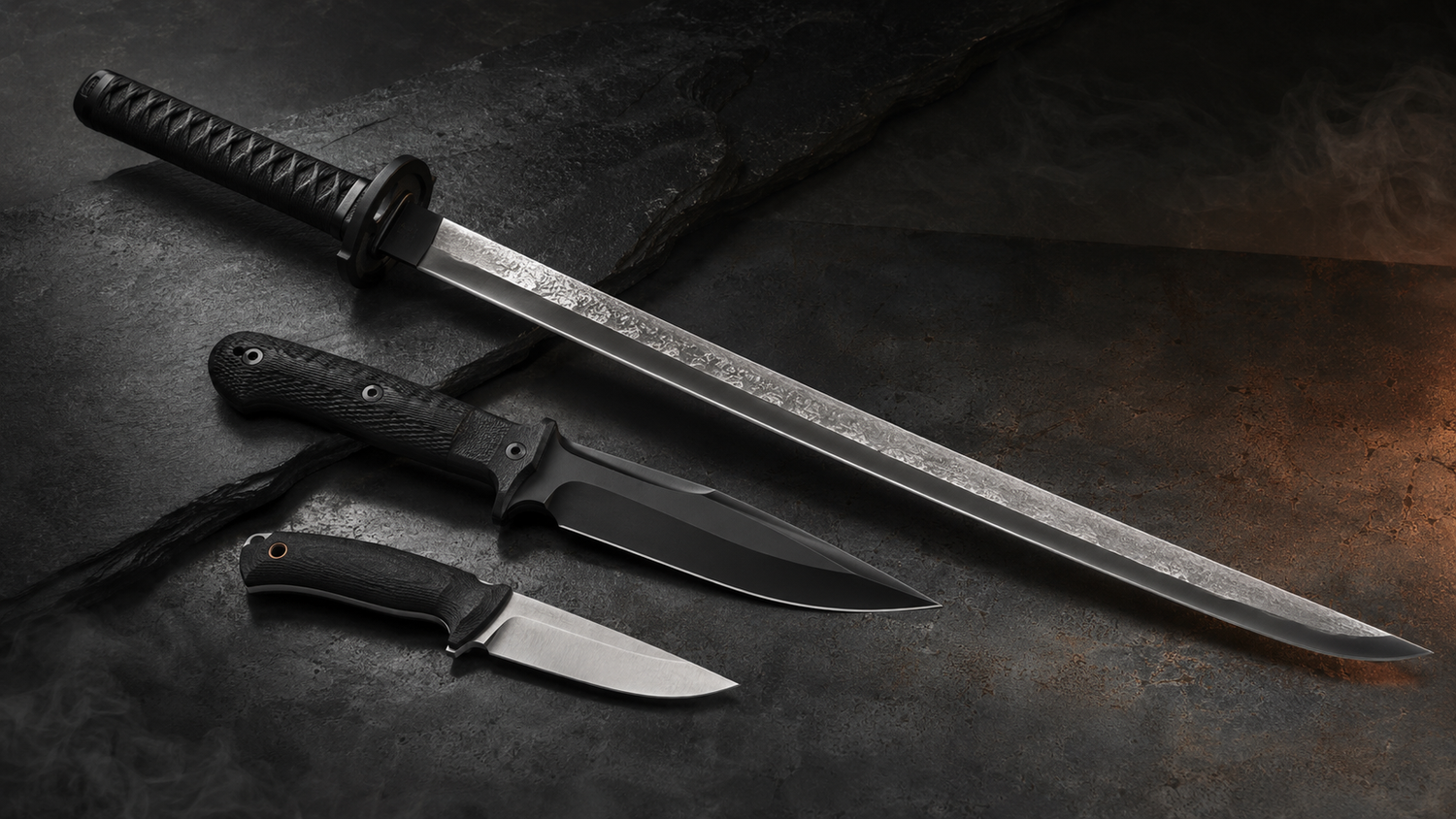
Blade steel is one of the first specifications people check when choosing a knife or sword, but a more expensive steel is not automatically the better choice. A compact EDC knife, a heavy-duty fixed blade and a full-length tactical sword place very different demands on the material. The right steel is the one that balances edge retention, toughness, corrosion resistance and maintenance for the way the blade is designed to be used.
This BoxKatana guide compares the steels most relevant to modern tactical knives and swords, including DC53, S30V, S7, SK5, 9SiCr, D2, AUS-8 and 60Si2Mn. It also explains why heat treatment, blade geometry and construction matter just as much as the name stamped on the blade.
What Makes a Good Knife or Sword Steel
No single number defines blade performance. Five characteristics should be considered together:
Edge retention
How long the edge continues cutting effectively before it needs sharpening. Wear-resistant carbides and appropriate hardness can improve edge life, although very high wear resistance may make sharpening slower.
Toughness
The ability to resist chipping, cracking and sudden breakage under stress. Toughness becomes increasingly important as a blade gets longer, thicker or more impact-oriented.
Corrosion resistance
How well the steel resists rust, staining and oxidation. Stainless steels generally require less maintenance, while carbon and tool steels should be cleaned, dried and lightly oiled.
Hardness
Usually expressed as HRC. Greater hardness can support edge retention and stability, but maximum hardness is not always desirable. The correct range depends on the steel, heat treatment, blade geometry and intended use.
Ease of sharpening
Some steels can be restored quickly with conventional stones, while high-wear steels may benefit from diamond or ceramic sharpening tools.
Knife and Sword Steel Comparison
The ratings below describe broad, relative tendencies rather than guaranteed performance. Heat treatment and edge geometry can move two blades made from the same steel in very different directions.
| Steel | Edge Retention | Toughness | Corrosion Resistance | Sharpening | Best Fit |
|---|---|---|---|---|---|
| S30V | High | Medium to High | High | Moderate | Premium EDC and compact knives |
| DC53 | High | High for a wear-resistant tool steel | Low to Medium | Moderate to Difficult | Tactical fixed blades and short swords |
| S7 | Medium | Very High | Low | Moderate | Impact-oriented large blades |
| SK5 | Medium | High | Low | Easy to Moderate | Large outdoor knives and tactical swords |
| 9SiCr | Medium to High | High | Low | Moderate | Full-tang tactical swords |
| 60Si2Mn | Medium | Very High | Low | Moderate | Long blades requiring resilience |
| D2 | High | Medium | Medium | Moderate to Difficult | Hard-use fixed blades |
| AUS-8 | Medium | Medium to High | High | Easy | Accessible everyday knives |
Understanding the Most Important Blade Steels
DC53 Tool Steel
DC53 is a cold-work tool steel developed to combine high hardness and wear resistance with improved toughness compared with traditional D2-type tool steels. In a knife, that property profile can produce strong edge stability and long cutting life, especially in thick fixed blades and compact tactical swords. It is not a fully stainless steel, so a protective finish and routine care remain important.
BoxKatana uses DC53 in designs such as the Shadow Fang Tactical Sword, where its wear resistance is paired with a substantial full-tang platform.
CPM S30V Stainless Steel
S30V is a powder-metallurgy stainless steel created specifically for cutlery. Its vanadium-rich carbide structure supports strong wear resistance and edge retention, while its chromium content provides useful corrosion resistance. It is a well-rounded premium choice for compact fixed blades, folding knives and EDC tools that need to hold an edge without requiring the maintenance of carbon steel.
S30V is usually more demanding to sharpen than AUS-8, but diamond or quality ceramic abrasives make routine maintenance straightforward. For most users, it offers a practical step up in edge life without moving into extremely difficult-to-sharpen steel territory.
S7 and S7XL Tool Steel
AISI S7 is a shock-resistant tool steel known for high impact toughness. That makes it especially relevant to larger blades, where resistance to cracking and gross failure can matter more than maximum slicing edge retention. It is not stainless and should be protected from moisture.
S7XL is a supplier or manufacturer-specific designation rather than a universal AISI grade. When evaluating any blade labeled S7XL, the maker's stated composition, heat treatment and hardness should be considered. In BoxKatana's catalog, the Phantom Saber S7XL represents this impact-focused tool-steel approach in a full-length tactical design.
SK5 High-Carbon Steel
SK5 is a Japanese high-carbon tool steel commonly chosen for outdoor knives, machetes and large fixed blades. It can take a keen edge, offers dependable toughness and is easier to restore than many highly alloyed wear-resistant steels. Its main tradeoff is corrosion resistance: the blade should be cleaned, dried and lightly oiled after handling or outdoor use.
The Iron Reaper Tactical Dao uses SK5 in a large full-tang platform where toughness, serviceability and structural reliability are central priorities.
9SiCr Alloy Tool Steel
9SiCr is a high-carbon alloy tool steel used where hardness, wear resistance and strength must be balanced. Silicon and chromium improve its performance beyond a basic carbon steel, while correct heat treatment allows it to support a durable edge in medium and long blades. Like other non-stainless tool steels, it benefits from a coating and regular maintenance.
The Sparta V2 Tactical Sword combines a 9SiCr full-tang blade with a modern protective finish and an engineered tactical construction.
60Si2Mn Spring Steel
60Si2Mn is a silicon-manganese spring steel selected for resilience, elastic strength and resistance to permanent deformation. Those characteristics make it particularly suitable for long blades, where the steel must tolerate bending stress across a much greater length than a pocket knife. It does not offer stainless-level corrosion resistance and should be maintained accordingly.
The Gorilla Tactical Knife Limited Edition demonstrates why spring steel remains relevant for oversized tactical designs that prioritize toughness and structural strength.
D2 Tool Steel
D2 is a high-carbon, high-chromium cold-work tool steel valued for wear resistance and edge retention. It is sometimes described as semi-stainless, but it can still stain or corrode without care. D2 works well in robust fixed blades where long edge life is valued, although it generally takes more effort to sharpen than simpler carbon steels.
AUS-8 Stainless Steel
AUS-8 is a practical stainless steel with good corrosion resistance, useful toughness and easy sharpening. It will not normally match S30V for wear resistance or edge life, but it is forgiving and quick to maintain. That makes AUS-8 a sensible choice for accessible everyday knives and users who prefer simple field sharpening.
Why the Best Knife Steel May Not Be the Best Sword Steel
A short knife can use high hardness and high wear resistance effectively because its compact blade experiences less leverage. A sword is a different engineering problem. As blade length increases, toughness, flexibility, weight distribution, tang construction and resistance to crack propagation become more important.
This is why premium stainless steels such as S30V are excellent in compact knives but are not automatically the ideal choice for long tactical swords. Steels such as S7, SK5, 9SiCr and 60Si2Mn can provide a more appropriate balance for large blades, especially when paired with controlled heat treatment and a strong full-tang structure.
Heat Treatment and Geometry Matter More Than Marketing
Steel composition defines the potential of a blade, but heat treatment determines how much of that potential is realized. Austenitizing temperature, quenching, tempering and final hardness all affect toughness, edge stability and wear resistance. Poor heat treatment can make a premium steel perform worse than a simpler steel processed correctly.
Geometry matters just as much. A thin slicing edge cuts efficiently but has less material behind it. A thick tactical edge sacrifices some slicing ability for stability. Blade thickness, grind, edge angle, distal taper and tang construction must work together with the selected steel.
How to Choose the Right Blade Steel
For premium EDC and compact knives
Choose S30V when corrosion resistance and long edge life are priorities. Choose AUS-8 when easy sharpening and value matter more than maximum wear resistance.
For tactical fixed blades
DC53 and D2 suit users who prioritize edge stability and wear resistance. S7 is better suited to designs where impact toughness is the dominant requirement.
For tactical swords and large blades
Look first at S7, SK5, 9SiCr and 60Si2Mn, then evaluate blade thickness, full-tang construction, heat treatment and total weight. A balanced design is more important than simply choosing the hardest steel.
For collectors and display
Steel still matters, but finish quality, construction, proportions, sheath design and long-term corrosion care may be equally important. Coated carbon or tool steel should still be wiped clean because moisture can reach exposed edges, markings and scratches.
Basic Blade Care by Steel Type
Stainless steels such as S30V and AUS-8: Wipe clean and dry after use. Stainless means corrosion-resistant, not corrosion-proof, especially around saltwater, sweat or acidic residue.
Tool steels such as DC53, S7 and D2: Keep the blade dry and apply a thin layer of protective oil for storage. Inspect exposed edges and scratches even when the blade has a coating.
Carbon and spring steels such as SK5, 9SiCr and 60Si2Mn: Clean promptly, dry completely and oil lightly. Avoid long-term storage in a damp sheath. For display pieces, inspect the blade periodically rather than leaving it untouched for months.
Frequently Asked Questions
Is S30V better than DC53?
S30V is the better choice when stainless performance, compact size and everyday edge retention are priorities. DC53 is better suited to many thick tactical fixed blades where high hardness, wear resistance and tool-steel toughness are desired. They solve different design problems.
Is harder steel always better?
No. Higher hardness can improve edge stability and wear resistance, but excessive hardness or poor heat treatment may reduce toughness. The target hardness should match the steel, blade geometry and intended application.
What is the best steel for a tactical sword?
There is no universal winner. S7 emphasizes impact resistance, SK5 offers a dependable balance of toughness and serviceability, 9SiCr supports hardness and edge stability, and 60Si2Mn provides spring-like resilience. Construction and heat treatment remain decisive.
Does a black coating prevent all rust?
No. A coating reduces exposure, but the cutting edge, engraved areas and any scratches can still corrode. The blade should still be cleaned, dried and maintained.
Final Recommendation
The best blade steel is not the steel with the highest score on a chart. It is the steel that fits the blade's size, geometry, construction and intended role. S30V is a strong premium choice for compact stainless knives. DC53 and D2 favor wear resistance in robust fixed blades. S7 is built around toughness. SK5, 9SiCr and 60Si2Mn remain highly relevant for large tactical blades where resilience matters.
Start with how you plan to use and maintain the blade, then compare the complete design rather than one specification. That approach will lead to a more reliable choice and a blade that better matches your collection.
Explore BoxKatana Blades by Design
Compare modern tactical knives, full-tang swords and collector-focused designs.
SHOP TACTICAL BLADES SHOP ALL KNIVESTechnical note: The property descriptions in this guide are general comparisons informed by published steelmaker data for DC53, S7 and CPM S30V. Actual blade performance varies with heat treatment, hardness, geometry, manufacturing quality and maintenance. Product specifications may change; check the individual product page before purchasing.

Leave a comment
All comments are moderated before being published.
This site is protected by hCaptcha and the hCaptcha Privacy Policy and Terms of Service apply.